The Russian campaign, after Minard: a homage in motion
Twenty-four steps, from the crossing of the Niemen to the return: each with the animated map that day, a painting of the time, and its sources.
1. 24 June: across the Niemen
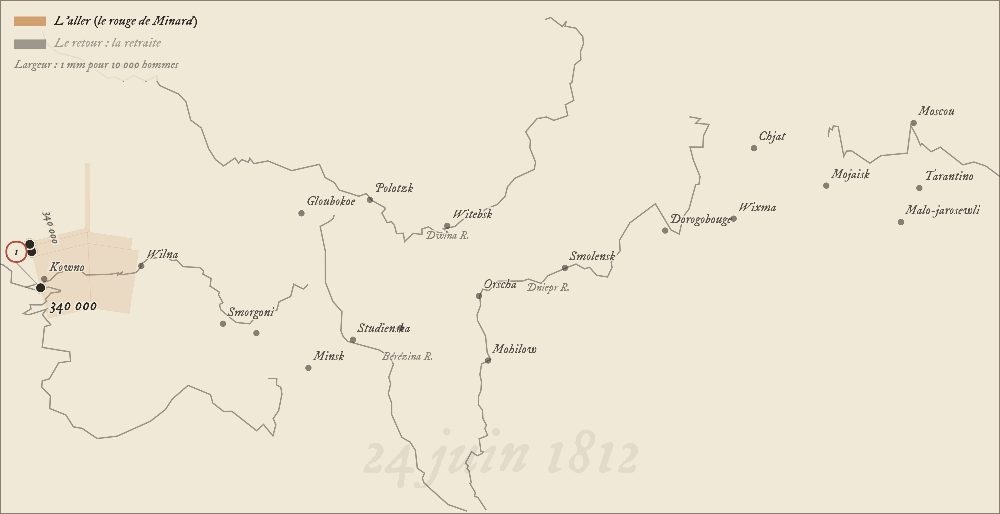

In Minard's figures, 422,000 men cross the Niemen into Russia at Kowno: the main army and two detachments. Fewer than half of Napoleon's soldiers are French: Poles, Germans, Italians, Swiss and others serve with them, from some twenty nations.
Source: Minard's legend (FR)

Source: World History Encyclopedia (EN), in French (FR)
Source: Fitzwilliam Museum (EN), L'Histoire par l'image: the Russian campaign (FR)
2. 28 June: Vilna
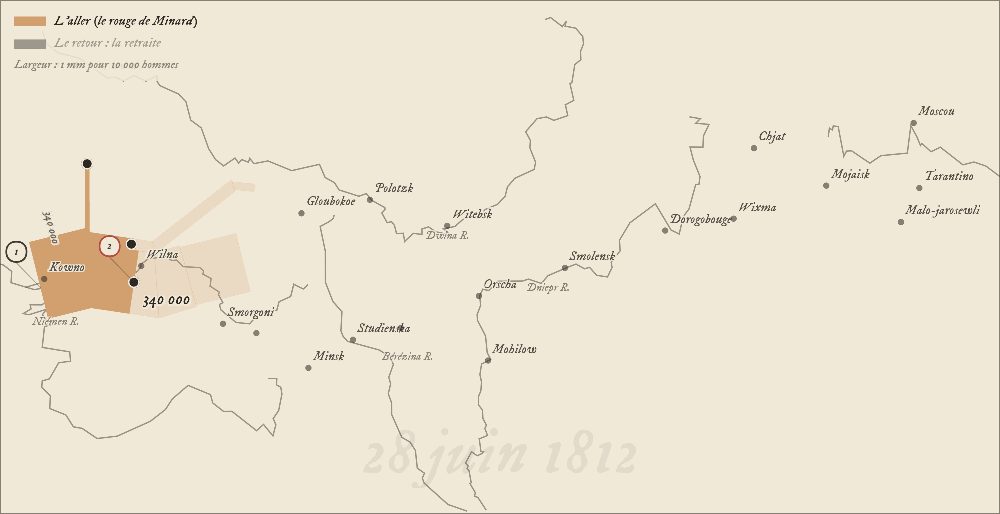

The army takes Vilna without a fight. Napoleon stays there until 16 July, while the Russian armies fall back to the east. The same day, the Poles of the Duchy of Warsaw proclaim their kingdom restored; Napoleon does not commit himself.
Source: napoleon-empire.org (EN), in French (FR)
Source: Fondation Napoléon: the advance (EN), in French (FR)
Source: Wikipedia: Duchy of Warsaw (EN), in French (FR), in Russian (RU)
3. July: the losses before the battles
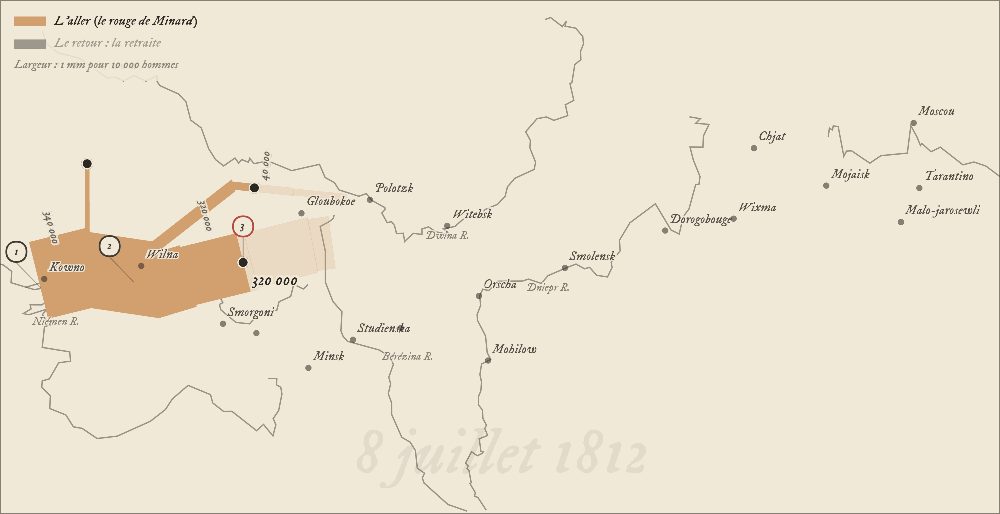
Heat, storms, typhus, dysentery and desertion: before its first big battle, the army has lost about 100,000 men. Minard's main band falls from 340,000 at the Niemen to 175,000 at Vitebsk.
Source: Wikipedia: French invasion of Russia (EN), in French (FR), in Russian (RU)
Source: World History Encyclopedia (EN), in French (FR)
4. 17 July: the Russians keep retreating
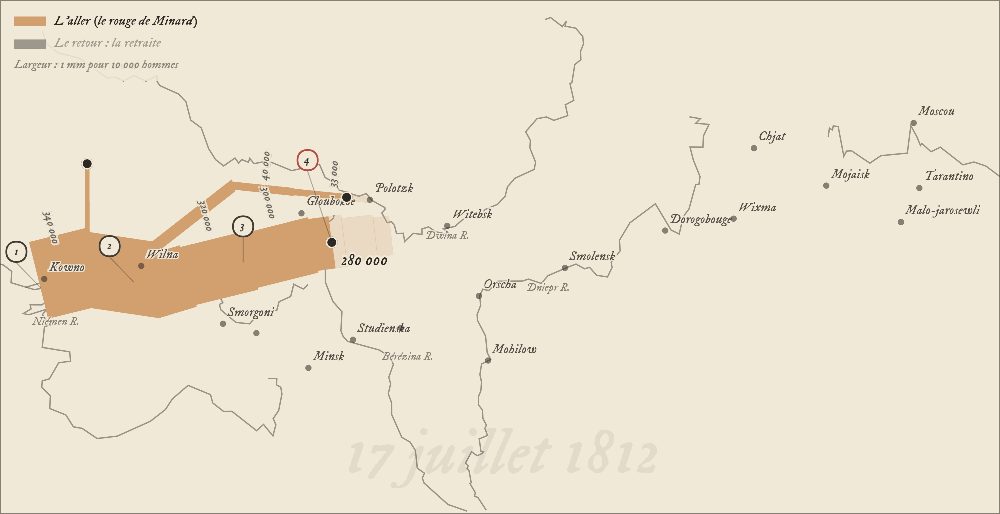

They leave their camp at Drissa and fall back again, destroying crops, bridges and depots behind them, and avoiding open battle: scorched earth.
Source: Fondation Napoléon: the advance (EN), in French (FR)
Source: World History Encyclopedia (EN), in French (FR)
5. 23 July: Mogilev, and Minard's simplification
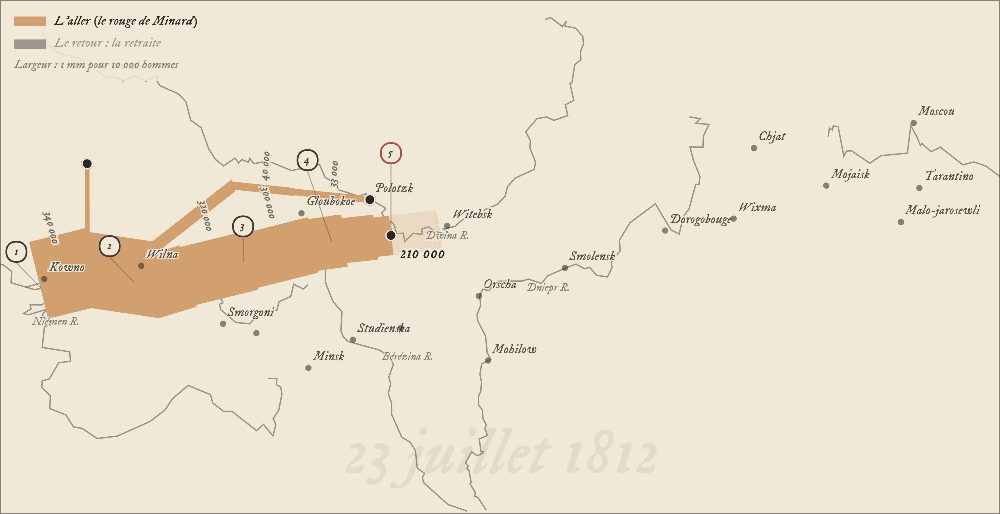
In the south, Davout stops the army of Bagration at Saltanovka: it cannot join Barclay's at Vitebsk. Minard does not draw their detour: he makes them march with the army.
Source: Wikipedia: Battle of Saltanovka (EN), in French (FR), in Russian (RU)
Source: Minard's legend (FR)
6. 28 July: Vitebsk
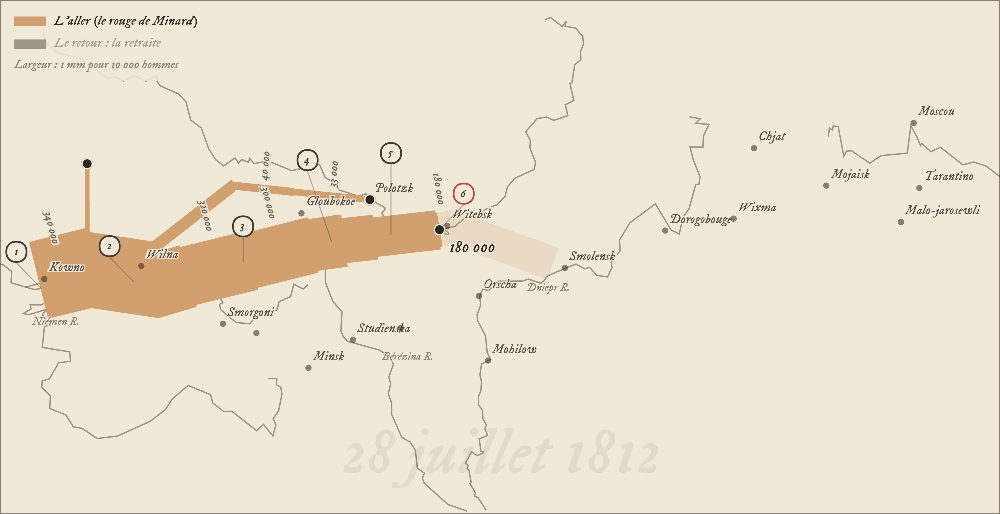

After a first big clash at Ostrovno, the Russians slip away again. In heat of about 30 °C, Napoleon rests his exhausted troops, and thinks of ending the year's campaign here.
Source: Fondation Napoléon: the advance (EN), in French (FR)
7. 16-18 August: Smolensk
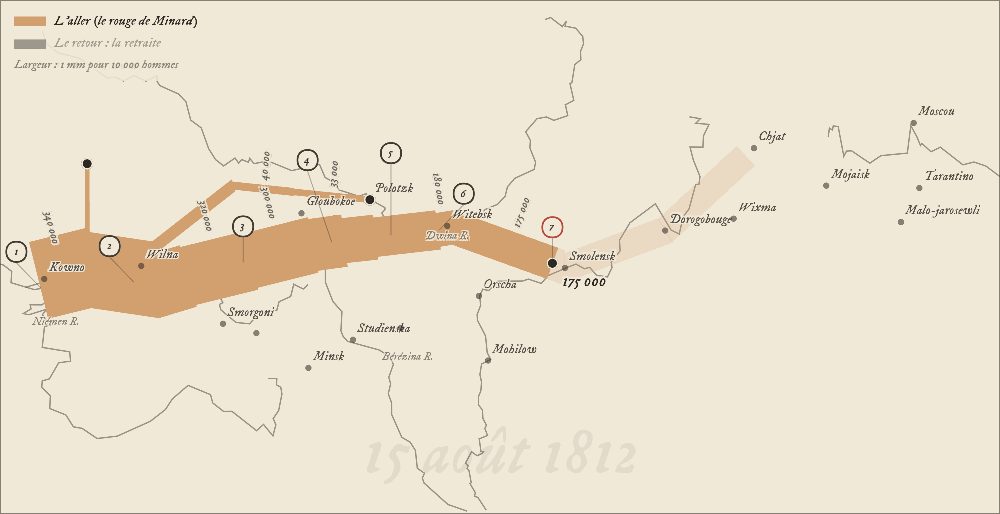

Napoleon takes the burning city after a two-day battle, but the Russian army withdraws once more. In the north, the detachment of Minard's upper band fights its own battle, at Polotsk.
Source: Fondation Napoléon: the advance (EN), in French (FR)
8. 29 August: Kutuzov
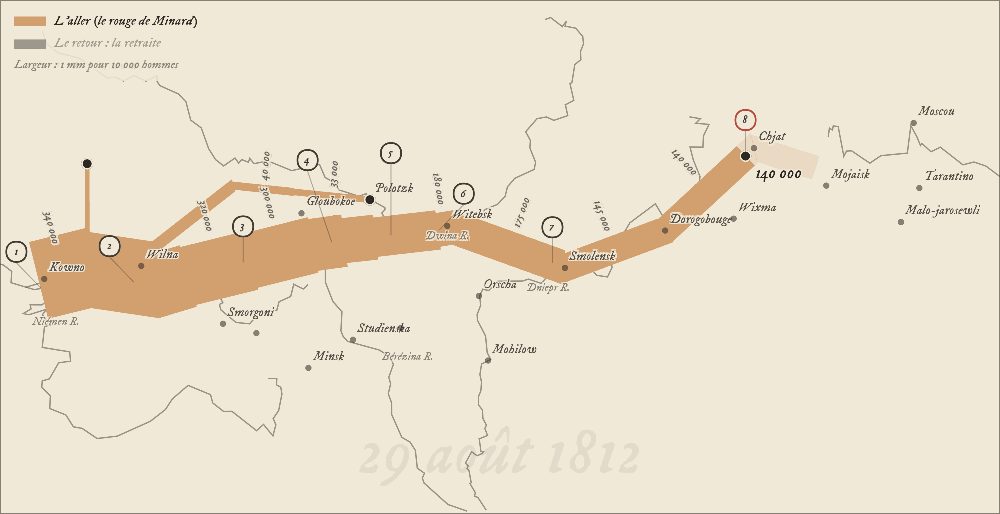
Kutuzov takes command of the retreating Russian armies. Nine days later, he gives battle.
Source: Fondation Napoléon: the advance (EN), in French (FR)
Source: napoleon-empire.org (EN), in French (FR)
9. 7 September: Borodino
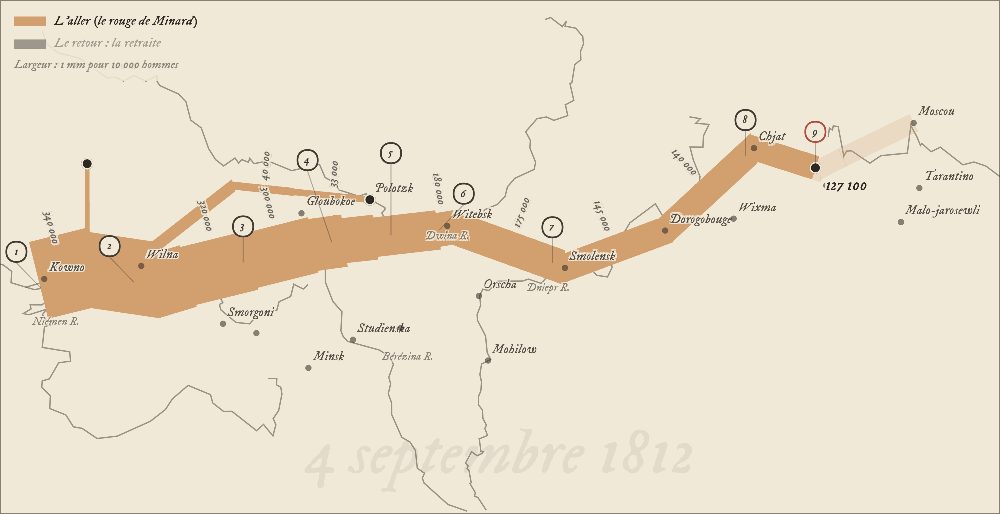

The two armies finally meet at Borodino, 72 miles west of Moscow: about 133,000 men under Napoleon against 120,000 under the Tsar. Around the battle, Minard's band falls from 127,000 to 100,000: his sources count differently.
Source: World History Encyclopedia, timeline (EN), Fondation Napoléon: the chronology of 1812 (FR)
Source: Fitzwilliam Museum (EN), L'Histoire par l'image: the Russian campaign (FR)
10. 14 September: Moscow
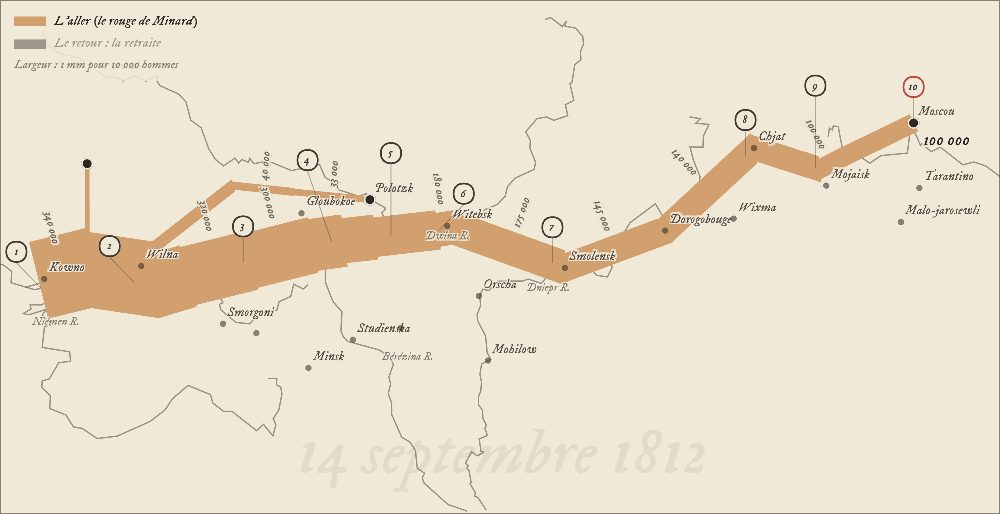

On Poklonnaya Hill, outside the city, Napoleon waits in vain for the keys of the Kremlin: Moscow is almost deserted. His troops occupy it that day; he enters on the 15th.
Source: Wikipedia: Poklonnaya Hill (EN), in French (FR), in Russian (RU)
Source: Fondation Napoléon: the advance (EN), in French (FR)
11. 14-18 September: the fire
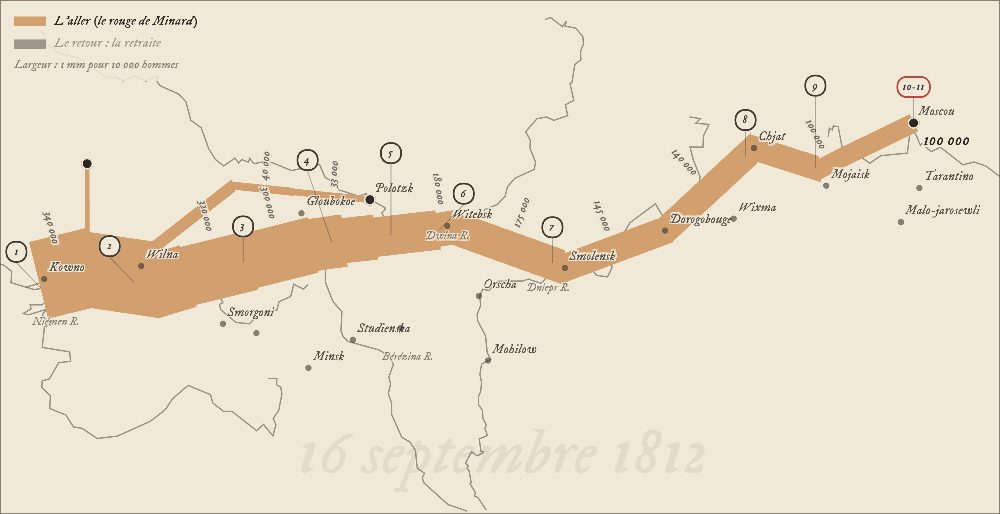

Fires break out across the city and burn for days, destroying about three quarters of it. On the 16th, Napoleon has to flee the Kremlin for the Petrovsky Palace; he comes back on the 18th.
Source: Wikipedia: Fire of Moscow (EN), in French (FR), in Russian (RU)
Source: Fondation Napoléon: the advance (EN), in French (FR)
12. Five weeks in Moscow
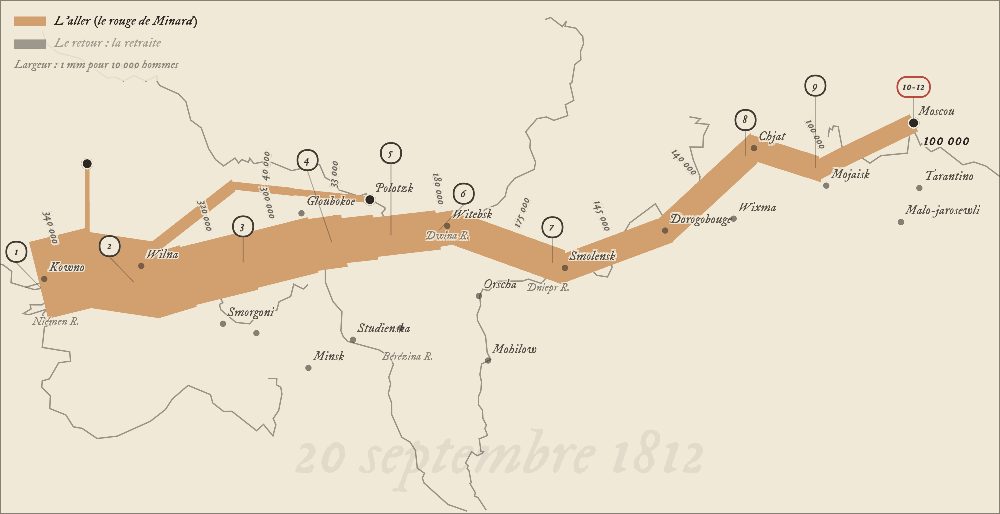

On 20 September, Napoleon writes to Tsar Alexander, blaming the fire on Moscow's governor, Rostopchin. On 4 October he sends Lauriston to Kutuzov, who refuses to negotiate. No answer ever comes.
Source: Napoleon's letter of 20 September (EN), in French (FR), in Russian (RU)
Source: Wikipedia: French occupation of Moscow (EN), in French (FR), in Russian (RU)
Source: Fondation Napoléon: the advance (EN), in French (FR)
13. The Russian side
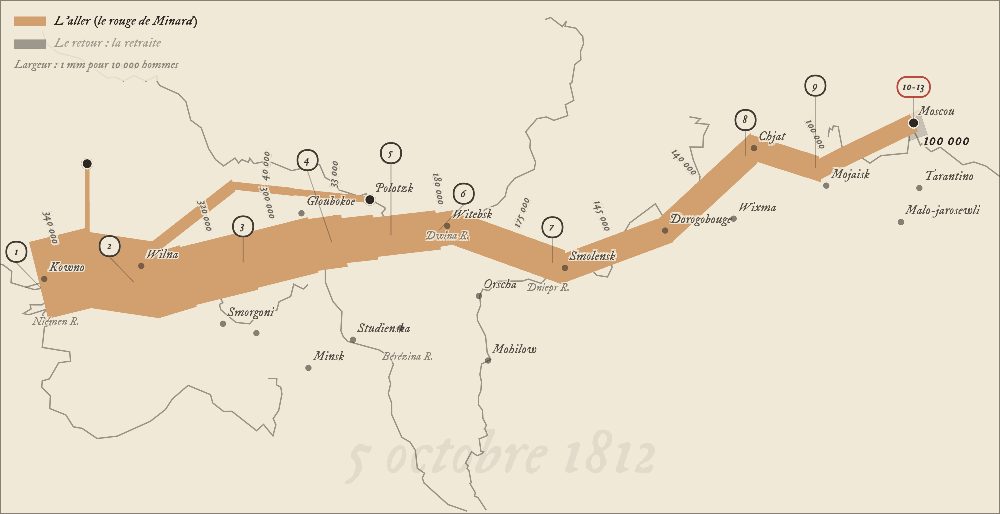
In Russia, this is the Patriotic War of 1812. Peasants and Cossacks harry the invaders, and partisans such as Denis Davydov and Alexander Figner raid their supply trains. Along the route, civilians die as much as soldiers, perhaps more.
Source: Wikipedia: French invasion of Russia (EN), in French (FR), in Russian (RU)
Source: Wikipedia: Denis Davydov (EN), in French (FR), in Russian (RU)
14. 18-19 October: the retreat
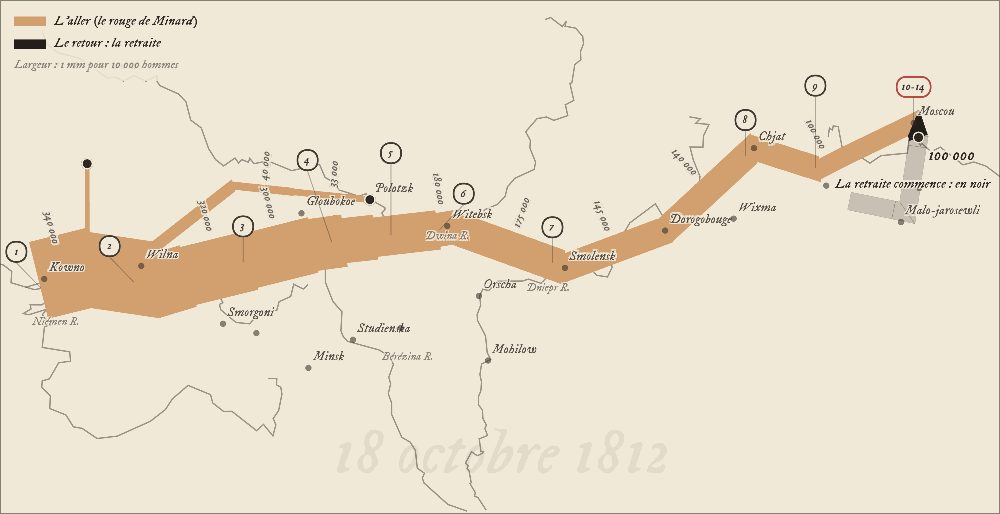

On the 18th, Kutuzov beats Murat at Vinkovo, and Napoleon decides to leave. The army leaves Moscow on the 19th (Minard's temperatures start on the 18th).
Source: napoleon-empire.org (EN), in French (FR)
Source: Fondation Napoléon: the retreat (EN), Paul Ganière, The retreat from Russia (FR)
15. 24 October: Maloyaroslavets
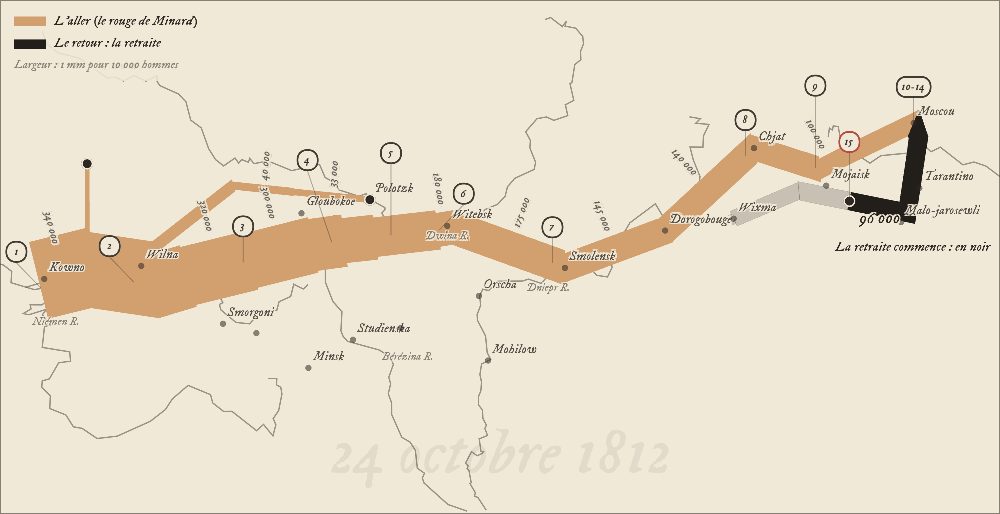

The town changes hands eight times. The French keep it, but Kutuzov bars the road to the south: the army must go back by the road it stripped bare on the way in.
Source: Wikipedia: Battle of Maloyaroslavets (EN), in French (FR), in Russian (RU)
16. 3 November: Vyazma
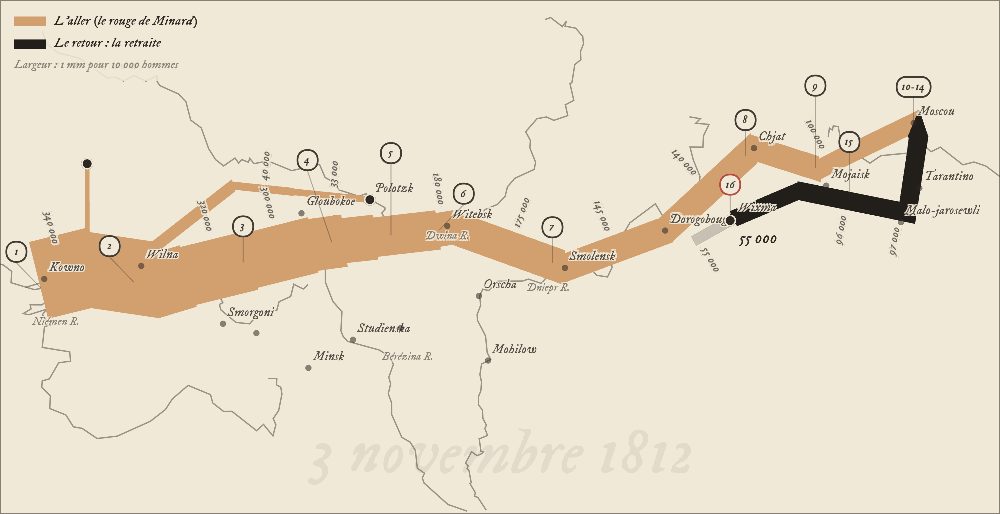
Miloradovich's troops attack the rear guard and inflict heavy losses.
Source: Wikipedia: Battle of Vyazma (EN), in French (FR), in Russian (RU)
17. 6 November: winter
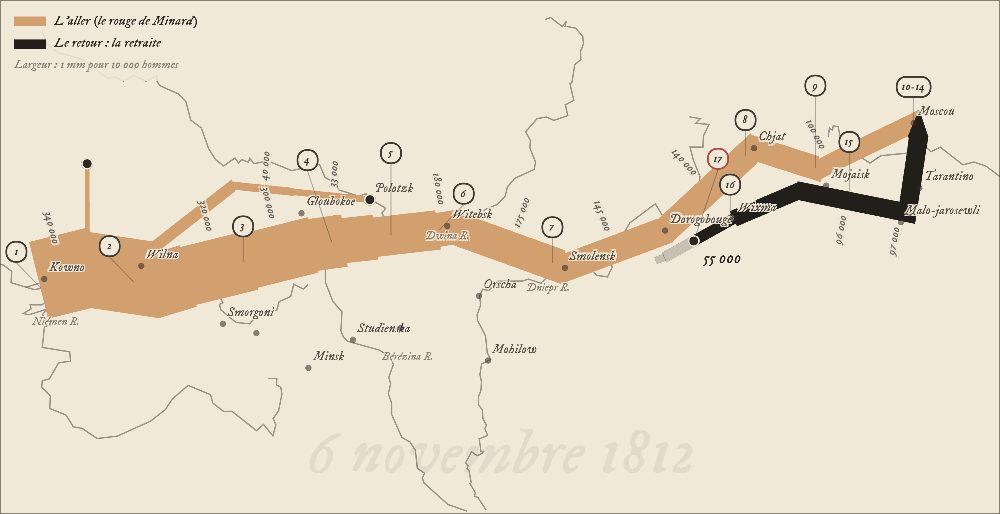

A blizzard: winter has come (Napoleon's own bulletin dates the cold from the 7th). In a few days, more than 30,000 horses die: cavalry and guns are left without them.
Source: Wikipedia: French invasion of Russia (EN), in French (FR), in Russian (RU)
Source: The 29th Bulletin (FR), in Russian (RU)
18. 9 November: Smolensk again
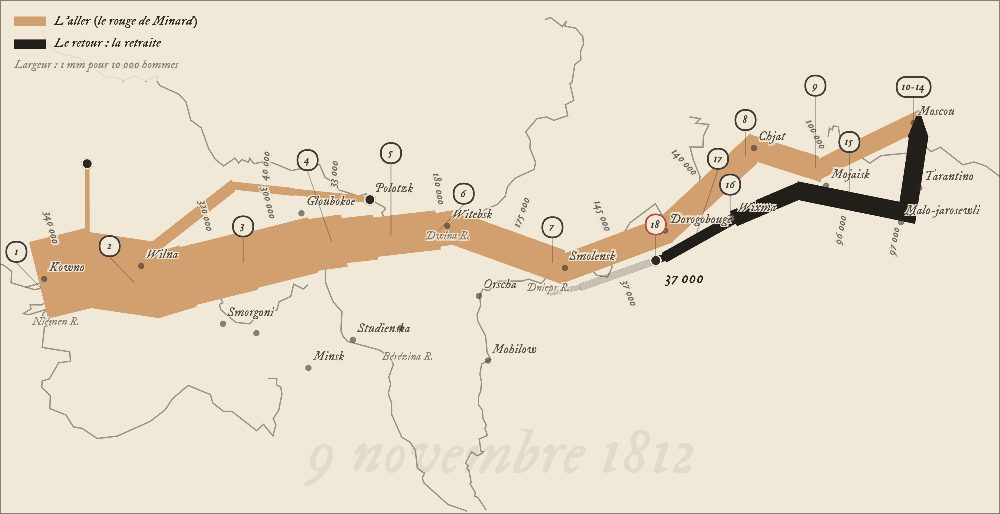

Napoleon reaches Smolensk. Figures differ: about 60,000 fighting men for one source, 37,000 in Minard's main band. On 14 November, Minard notes -21 degrees Réaumur (-26 °C).
Source: World History Encyclopedia, timeline (EN), Fondation Napoléon: the chronology of 1812 (FR)
Source: Minard's legend (FR)
19. 15-18 November: Krasnoi
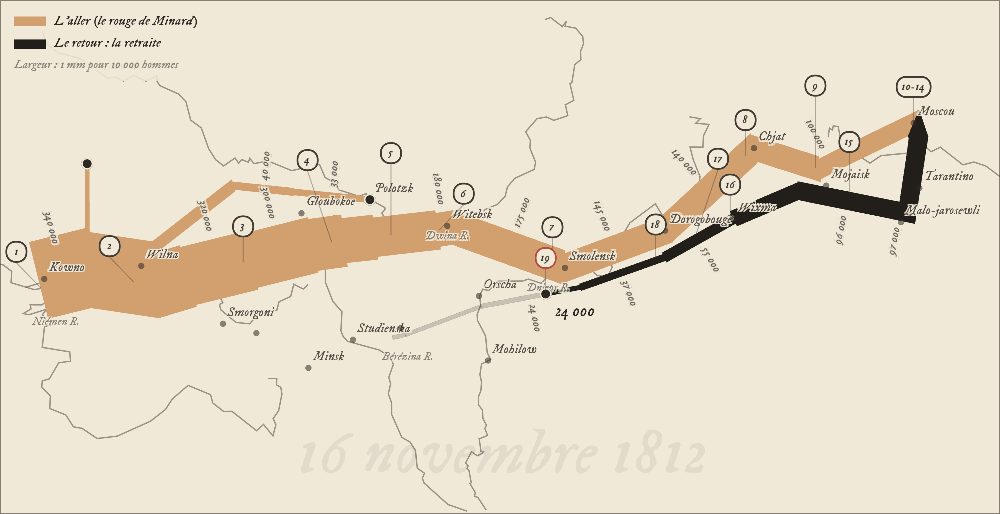

Kutuzov strikes the strung-out columns at Krasnoi and takes about 26,500 prisoners. Cut off, Ney's rear guard escapes across the ice of the Dnieper.
Source: Wikipedia: Battle of Krasnoi (EN), in French (FR), in Russian (RU)
20. 26-29 November: the Berezina
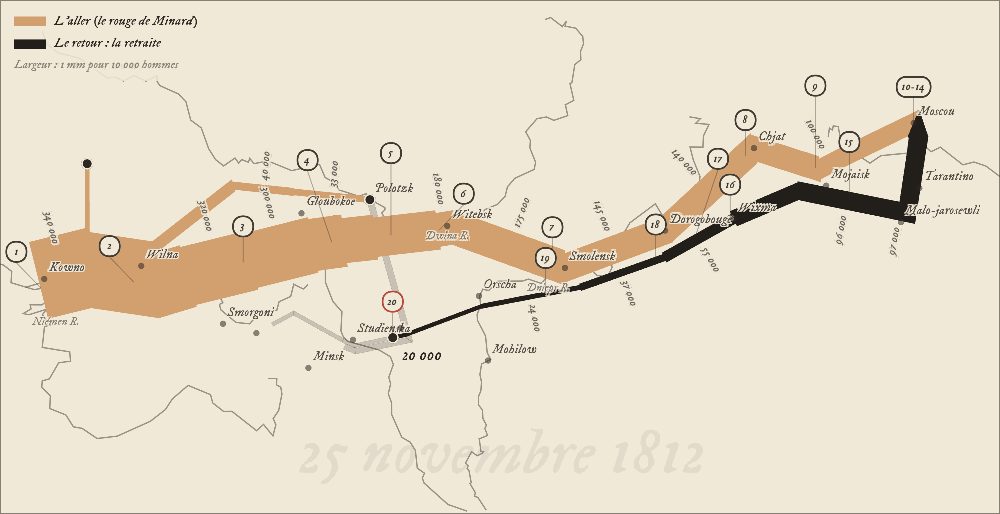

Harried by Russian armies, the remnants cross the river on bridges built by Eblé's pontoneers, and narrowly escape destruction.
Source: World History Encyclopedia, timeline (EN), Fondation Napoléon: the chronology of 1812 (FR)
21. 3 December: the 29th Bulletin
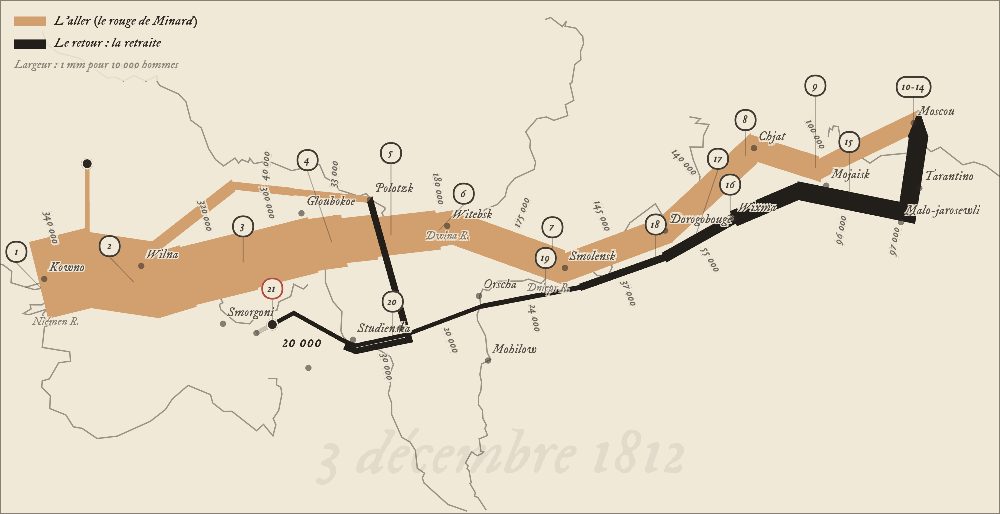
At Molodechno, Napoleon admits the disaster in his 29th Bulletin, read in Paris two weeks later. It ends: "His Majesty's health has never been better."
Source: The 29th Bulletin (FR), in Russian (RU)
Source: Fondation Napoléon: the retreat (EN), Paul Ganière, The retreat from Russia (FR)
22. 5 December: Napoleon leaves
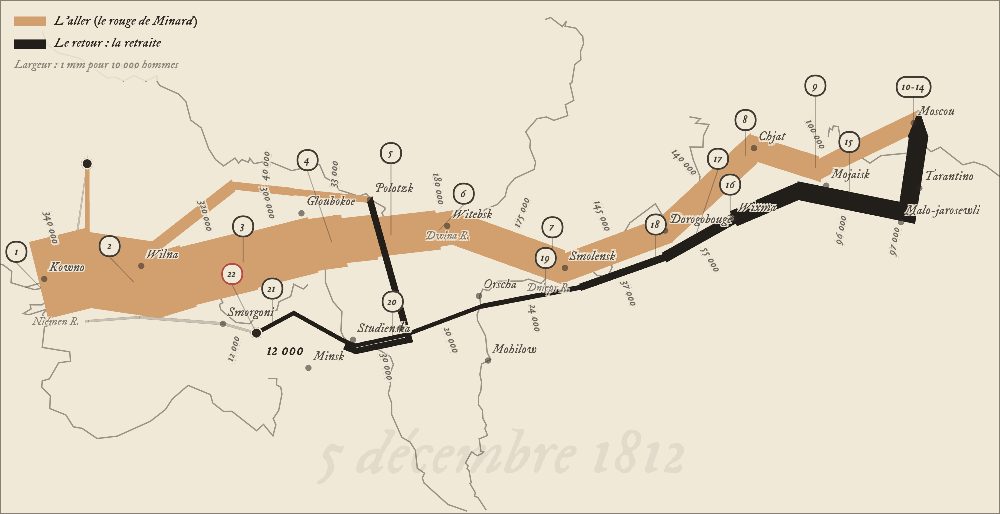

At Smorgoni, Napoleon leaves the army by sleigh. He is in Paris on 18 December. On the 7th, at Vilna, Minard records -26 degrees Réaumur: -32 °C.
Source: Fondation Napoléon: the retreat (EN), Paul Ganière, The retreat from Russia (FR)
Source: Minard's legend (FR)
23. 14 December: back across the Niemen
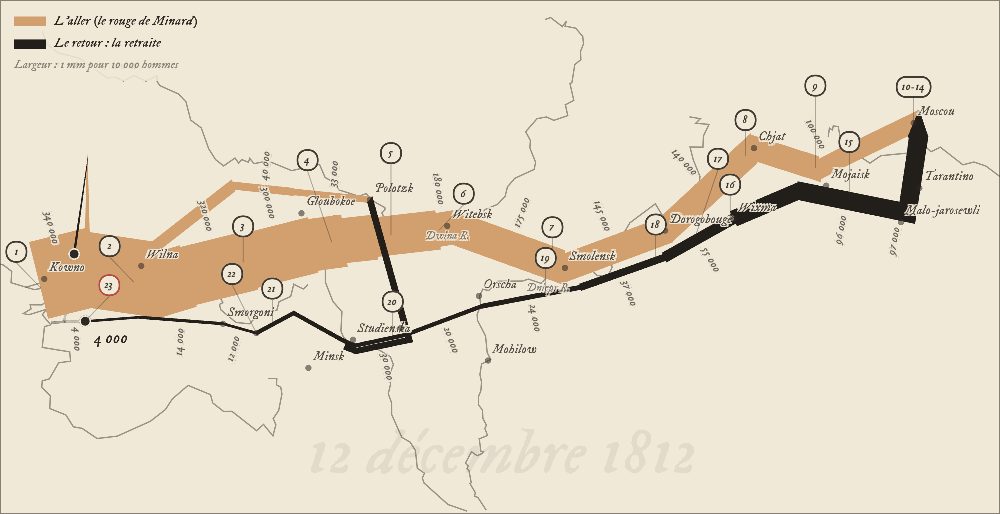

Ney leads the rear guard back across the river with barely a thousand men. In Minard's figures, about 10,000 of the 422,000 return. Counting both sides, soldiers and civilians, the campaign caused about a million deaths.
Source: Wikipedia: French invasion of Russia (EN), in French (FR), in Russian (RU)
Source: Minard's legend (FR)
Source: World History Encyclopedia, timeline (EN), Fondation Napoléon: the chronology of 1812 (FR)
24. Why Minard drew it
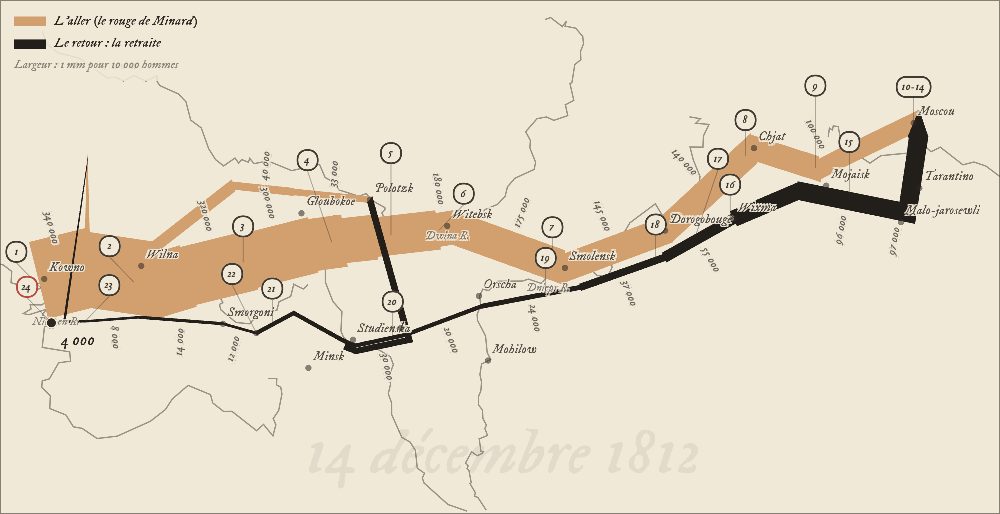

His legend says: to let the eye judge how the army shrank. His son-in-law wrote that the map "inspires bitter reflections on the human cost of the thirst for military glory". Michael Friendly reads it as a statement against war.
Source: Minard's legend (FR)
Source: Michael Friendly, Minard's life (EN), in French (FR)
Source: Michael Friendly, 2002 (EN), Éric Mauvière, Minard's "brutal eloquence" (FR)